
Building Your System
What Is a Dot Grid Notebook? Dot vs Grid vs Lined
A dot grid notebook uses faint dots instead of lines or squares. See how dot grid compares to grid, graph, and lined, and when to use each.
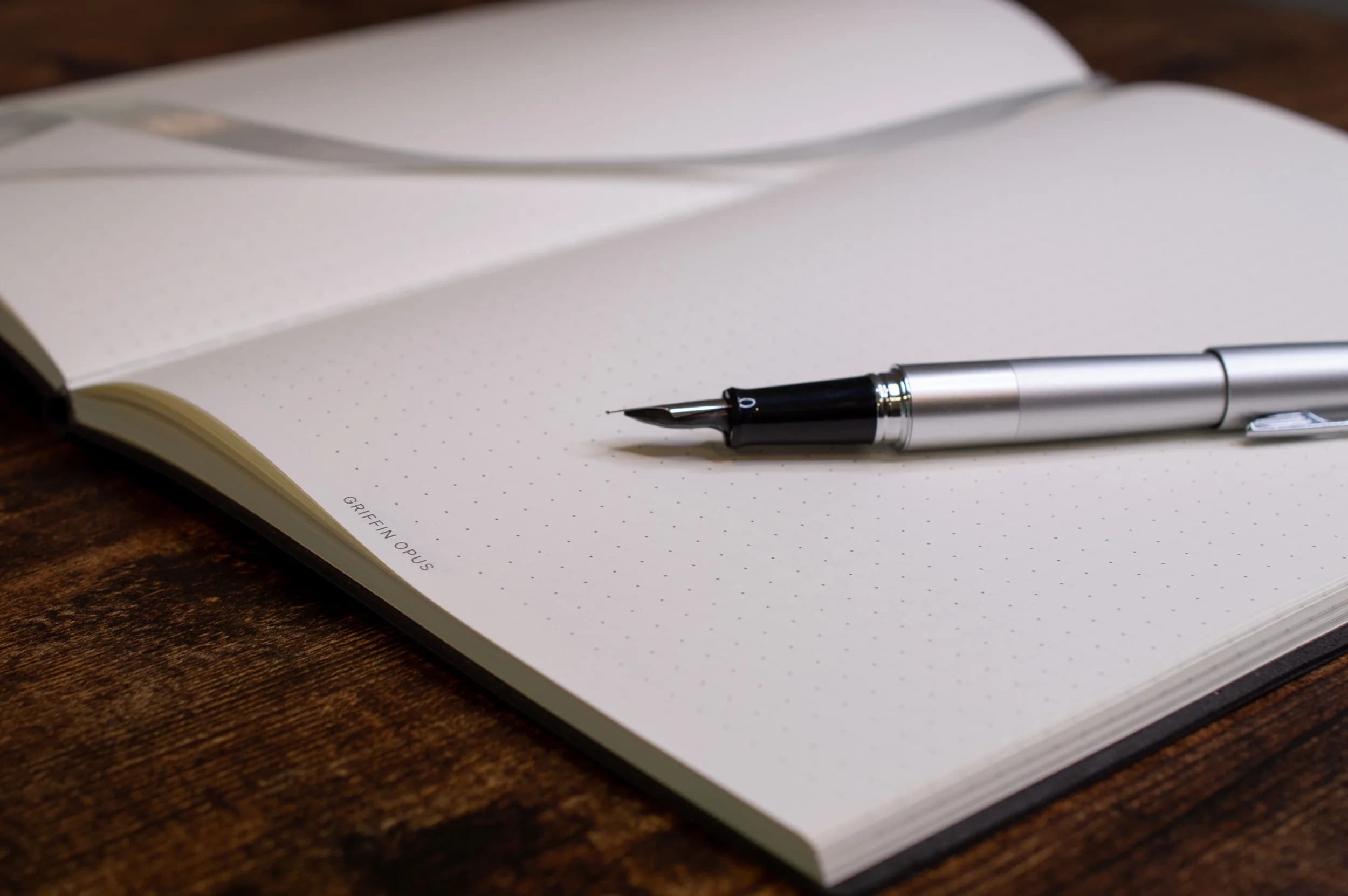
A dot grid notebook is a notebook printed with a grid of small, faint dots instead of solid lines or full squares. The dots sit at the corners of an invisible grid, so they guide your writing, tables, and sketches without the heavy printed lines you find on graph or lined paper. The result is a page that gives you structure when you want it and stays quiet when you do not.
Dot grid has become the default choice for planners, bullet journals, and anyone who writes and draws on the same page. Below is what it is, how it compares to grid, graph, lined, and blank paper, and when each one is the right tool.
What is a dot grid notebook?
In a dot grid notebook, the page is covered in evenly spaced dots, and each dot marks where grid lines would cross. You can use the dots as anchors to write in straight rows, line up columns, draw boxes, or map a layout, then ignore them completely when you want the page to feel open. Because the dots are light, they do not compete with your ink the way a full grid or ruled lines can.
Griffin Opus prints a dot grid at 5mm spacing on 80gsm uncoated B5 paper (176 × 250 mm / 6.9 × 9.8 in) across its notebooks and its Modular Binder, which ships with 30 dot-grid sheets. The dots are kept in a light, low-density gray, so the structure supports your thinking without taking over the page.
Dot grid vs grid vs graph vs lined vs blank
The short version: dot grid and graph paper both use a grid, but graph paper prints the full square lines while dot grid marks only the corners with dots. Lined paper gives you horizontal rules for prose. Blank gives you nothing and total freedom. Here is how they compare.
| Format | What the page shows | Best for | Main trade-off |
|---|---|---|---|
| Dot grid | Faint dots at the grid corners | Planning, tables, trackers, light sketching, mixed writing and drawing | Less guidance than full lines for dense text |
| Square grid / graph paper | Full printed squares | Math, graphs, technical drawing, precise diagrams | Lines can feel busy and show behind your writing |
| Lined / ruled | Horizontal rules | Long-form writing and notes | No vertical guidance for tables or drawing |
| Blank | Nothing | Free sketching, mind maps, total freedom | No structure to keep writing straight |
One point worth clearing up: a "grid notebook" or "gridded notebook" can mean either style, so the words get used loosely. If you see full printed squares, that is square grid or graph paper. If you see only dots, that is dot grid. Griffin Opus makes dot grid, not graph paper, because dots give structure for planning and tables while keeping the page calm.
Why choose dot grid for planning, tables, and sketching?
Dot grid earns its popularity because it does several jobs on one page. The dots let you rule a clean table or a habit tracker in seconds, keep a to-do list aligned, block out a daily schedule, and still turn the page to sketch an idea. You get the discipline of a grid for anything structured, and the freedom of near-blank paper for anything loose. The dots keep your lines from drifting crooked, so your writing stays neat, while still leaving the page open enough to think and sketch freely. That mix of structure and creative freedom is the flexibility people love about dot grid, because one fixed layout does not have to fit every kind of work.
Is dot grid good for bullet journaling?
Yes. Dot grid is the paper most closely associated with bullet journaling, the planning method popularized by Ryder Carroll. The dots make it easy to draw the collections, trackers, and logs a bullet journal uses, without pre-printed lines dictating the layout.
Griffin Opus is built for focused work rather than decorative craft spreads, but the same dot grid that suits a bullet journal is what makes our pages adaptable. If you want to start a bullet journal, a B5 dot grid notebook gives you the room and the structure to do it. If your planning is more about meetings, projects, and daily focus, the Modular Binder lets you swap in the right page instead.
Quick answers
What is a dot grid notebook used for?
A dot grid notebook is used for planning, note-taking, tables, trackers, and light sketching. The faint dots help you write in straight rows and line up columns or boxes, while staying out of the way when you want an open page. That mix makes dot grid popular for planners, bullet journals, and work notebooks.
Is dot grid better than lined paper?
It depends on the task. Dot grid is more versatile because it handles writing, tables, and drawing on the same page. Lined paper is better for long passages of prose, where horizontal rules keep dense text tidy. For planning and mixed use, most people prefer dot grid, and for pure writing, lined still has an edge.
What is the difference between dot grid and graph paper?
Dot grid marks only the corners of the grid with small dots, while graph paper prints the full square lines. Both give you the same underlying grid to work from, but dot grid keeps the page lighter and less busy, so your writing stands out. Graph paper suits precise technical work where you want every line visible.
Is dot grid good for bullet journaling?
Yes, dot grid is the standard paper for bullet journaling. The dots let you draw trackers, logs, and custom layouts freely without pre-printed lines locking you in. A B5 dot grid notebook gives you enough space for full weekly or monthly spreads.
What is the spacing between dots on dot grid paper?
Dot spacing varies by notebook, and five millimeters is the most common across the category, and the spacing Griffin Opus uses. A smaller spacing fits more detail on the page, while a wider spacing gives larger handwriting more room. The spacing is measured from the center of one dot to the center of the next.