Productivity Methods
Working Deeply in a Distracted World
Fragmented attention is the real productivity tax. Here's why a single page, not another app, is the most reliable way to reclaim focus and do deep work.
The average knowledge worker checks their inbox or a messaging app every six minutes. Not because the work demands it, but because the habit does. Each switch costs far more than the seconds it takes: research on attention residue shows that a fragment of your focus stays stuck on the previous task long after you’ve moved on. The result is a full day of work that somehow produces half a day of results.
This is the real productivity tax. Not a lack of tools, an excess of them, each one competing for the same scarce resource: your attention.
Deep work is a place, not a feeling
We tend to talk about focus as a mood that strikes when conditions are right. It’s more useful to treat it as a place you deliberately enter: one with a clear edge between “in” and “out.” The most reliable edge isn’t a productivity app with another set of notifications. It’s a single, physical surface that can only hold one thing at a time: a page.
A page can’t notify you. That’s not a limitation: it’s the entire point.
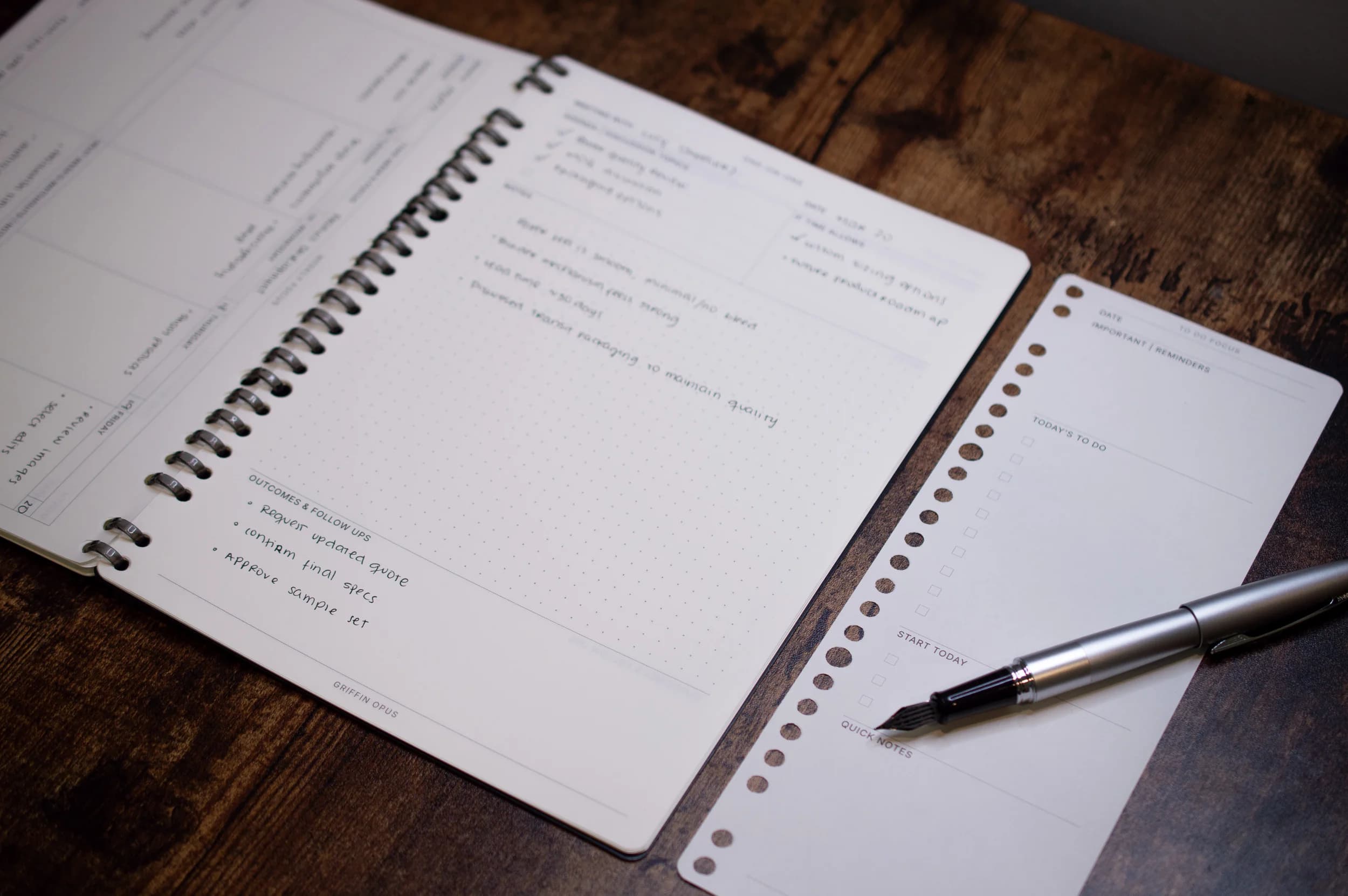
When your plan for the next ninety minutes lives on paper in front of you, there’s nothing to tab away to. The medium enforces the focus that willpower alone can’t sustain.
Three moves that protect deep work
You don’t need a new system to start. You need to remove friction from the one decision that matters, what to work on next, and then defend it.
- Choose the day before. Decide your two or three most important blocks the evening prior, when you’re calm, not at 9am when the inbox is loudest.
- Give each block a page. One surface, one intention. Capture stray thoughts in the margin instead of chasing them. They’ll wait.
- Close the loop in writing. End each block by noting what’s done and what’s next. This is what lets you leave the work and actually recover.
Why analog holds up
Writing by hand is slower than typing, and that’s a feature. The added friction forces you to summarize rather than transcribe, which is exactly the cognitive work that turns information into understanding. A page also has no version history, no sync conflict, and no algorithm deciding what you see next. It shows you one thing: the work in front of you.
None of this requires abandoning your digital tools. It requires giving your thinking a home they can’t interrupt. For a lot of professionals, that home is a single page instead of another app, one they can carry from the desk to the meeting room and back.
Start small. Tomorrow, plan one deep-work block on paper before you open a screen. Protect it for ninety minutes. Then notice how much further half a day of real focus takes you than a full day of fragmented effort.
Quick answers
Can working on paper help me focus in a distracted, screen-heavy day?
It can, for many people. A page cannot notify you or open a second tab, so there is nothing to switch to while you work. When the plan for the next block sits on paper in front of you, the medium itself removes the pull of the screen. That constraint is what many people find holds their attention.
How do I stop my attention scattering across apps all day?
For many people, it helps to give one task one surface. Choose your two or three important blocks the evening before, put each on its own page, and park stray thoughts in the margin instead of chasing them. With the next decision already made and on paper, there is less to pull you between screens.
Put it into practice
Build your system.
Start with the binder and add the pages that match how you actually work.
Build your system →