
Building Your System
B5 vs A5: Which Planner Size Fits You (Plus A4)
B5 vs A5, side by side, plus where A4 fits. A clear size comparison so you can pick the planner page that matches how and where you actually work.
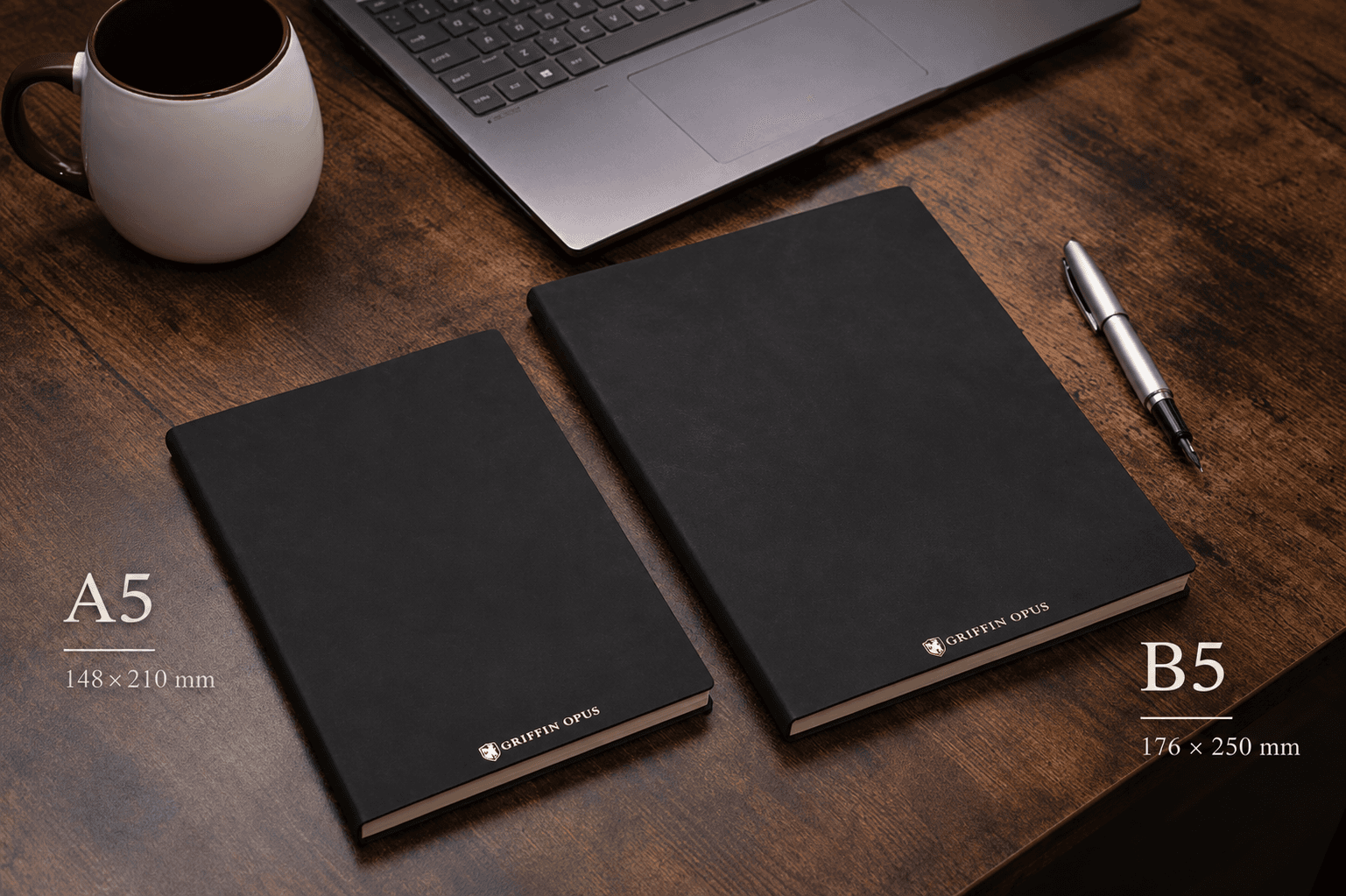
Almost everyone shopping for a planner is really deciding between two sizes: A5 and B5. A5 is the popular default, and a genuinely good one when you want a lighter, more compact page for daily planning. B5 is the size people reach for when they want one page that covers the desk, the meeting, and the commute without switching. So let's put them next to each other, add A4 for the desk-bound case, and figure out which page fits the way you work.
Quick answer
Choose B5 if you want one page for the desk, the meeting, and the commute, and your day is more than quick capture.
Choose A5 if your day is mostly fast planning and lists, and the lightest possible carry matters most.
| A5 148 × 210 mm · 5.8 × 8.3 in | B5 176 × 250 mm · 6.9 × 9.8 in | A4 210 × 297 mm · 8.3 × 11.7 in | |
|---|---|---|---|
| Room to write | Comfortable for daily planning and lists | More width and height, room for a full line or a rough table | The whole surface, generous for drafts |
| Carry | Very easy, slips into most bags | Still bag-friendly, slim enough to carry daily | Rarely carried, lives on the desk |
| Best for | Light daily planning, easy everyday carry | Desk, meetings, and travel, all in one | Fixed desk work you never carry |
Most people choose a planner by its cover and discover its size only later, usually at the wrong moment: when the page runs out mid-thought, or when the thing turns out to be too large to slip into the bag they carry every day. Size is the quietest decision in stationery and the one you live with longest. This planner size guide walks through the common formats, what each is good for, and how to match a page to the way you actually work.
The sizes, measured
The dimensions matter less as numbers than as a feel in the hand. Still, it helps to see them side by side, from most portable to most expansive.
Personal (95 × 171 mm / 3.7 × 6.7 in): pocketable, built for lists and quick capture rather than sustained writing.
A5 (148 × 210 mm / 5.8 × 8.3 in): the popular middle ground: light to carry, roomy enough for daily planning.
B5 (176 × 250 mm / 6.9 × 9.8 in): noticeably wider and taller than A5, with room to think, yet still slim enough to carry.
Half-letter (140 × 216 mm / 5.5 × 8.5 in): the North American cousin of A5, close in feel, common in ring systems.
A4 (210 × 297 mm / 8.3 × 11.7 in): a full desk page: generous for diagrams and drafts, but rarely something you carry.
The trade-off nobody escapes
Every size sits somewhere on a single line between writing space and portability, and you cannot move toward one without moving away from the other. A Personal or pocket page goes everywhere and asks you to write small and briefly. An A4 page gives you the whole surface a plan sometimes needs, then stays on the desk because it will not fold into a life in motion.
The question worth asking is not which size is best, but where you do your real thinking. If it happens at a fixed desk, a larger page costs you nothing and gives you room. If it happens in transit, on trains, in meeting rooms, at the corner of a café table, the page has to earn its place in your bag every day.
A page that is too small quietly edits your thinking down to fit it. A page that is too large stays home. The right one disappears, and only the work remains.
Why B5 is the professional's sweet spot
For people who need room to think but still want to carry their pages, B5 resolves the trade-off better than most. It is meaningfully larger than A5: enough width for a full line of notes, a rough table, or a diagram sketched in the margin, without crossing into the desk-bound territory of A4. You can spread a project across a spread and still close the cover and go.
This is the size the Modular Binder is built around, and the choice is deliberate. B5 suits the professional who moves between focused desk work and the meetings, commutes, and quieter corners where ideas often actually arrive. It gives thinking somewhere to land while staying light enough to travel: the balance behind carrying focused work lightly rather than choosing between space and mobility. If you would rather not assemble it yourself, the simplest way to start is a ready-made B5 system.
Planner sizes: quick answers
How big is A5?
A5 is 148 × 210 mm, or 5.8 × 8.3 inches, about half an A4 page, and the most popular everyday planner size.
Is B5 bigger than A5?
Yes. B5 (176 × 250 mm / 6.9 × 9.8 in) is noticeably wider and taller than A5 (148 × 210 mm / 5.8 × 8.3 in), which is what gives you room for a full line of notes or a rough table while the page still fits in a bag.
What size is A4, and A6?
A4 is 210 × 297 mm (8.3 × 11.7 in), a full desk page. A6 is 105 × 148 mm (4.1 × 5.8 in), a pocket size, roughly half of A5.
What are the planner sizes in inches?
A4 is 8.3 × 11.7 in, B5 is 6.9 × 9.8 in, A5 is 5.8 × 8.3 in, Half-letter is 5.5 × 8.5 in, A6 is 4.1 × 5.8 in, and Personal is 3.7 × 6.7 in.
Should I choose A5 or B5?
Choose B5 if you want one page that covers the desk, the meeting, and the commute without switching, especially if your work is planning and drafting rather than quick capture. Choose A5 if your day is mostly fast lists and light daily planning and you want the smallest possible carry. Both are bag-friendly; the difference is how much room your thinking needs.
Is B5 too big to carry every day?
No. B5 is noticeably roomier than A5 on the page, but it's still slim enough to carry daily, and the Modular Binder holds up to about 40 sheets, which keeps the whole thing thin in a bag. The size that's actually hard to carry is A4, which is why that one stays on the desk. B5 was chosen for the Modular Binder precisely because it's the largest size you'll still carry every day.
Choosing for how you work
Start from your day, not the page. If most of your writing is capture: reminders, quick lists, a line before it escapes, a smaller format keeps up. If your work is planning, drafting, and thinking through problems on paper, you want room, and B5 or A5 will serve you far longer than a pocket format that fills too fast.
The honest test is portability. A page you leave at home is a page you stop using. Choose the largest format you will genuinely carry, and no larger. Today, take the notebook you already own, open it flat, and write for ten minutes. You will feel quickly whether the page is giving your thinking room or quietly cutting it short.
Put it into practice
Build your system.
Start with the binder and add the pages that match how you actually work.
Build your system →