
Building Your System
How to Build a Paper System That Evolves
Learn how to build a paper system that grows with your work: start small, give each page one job, and swap inserts as your responsibilities shift.
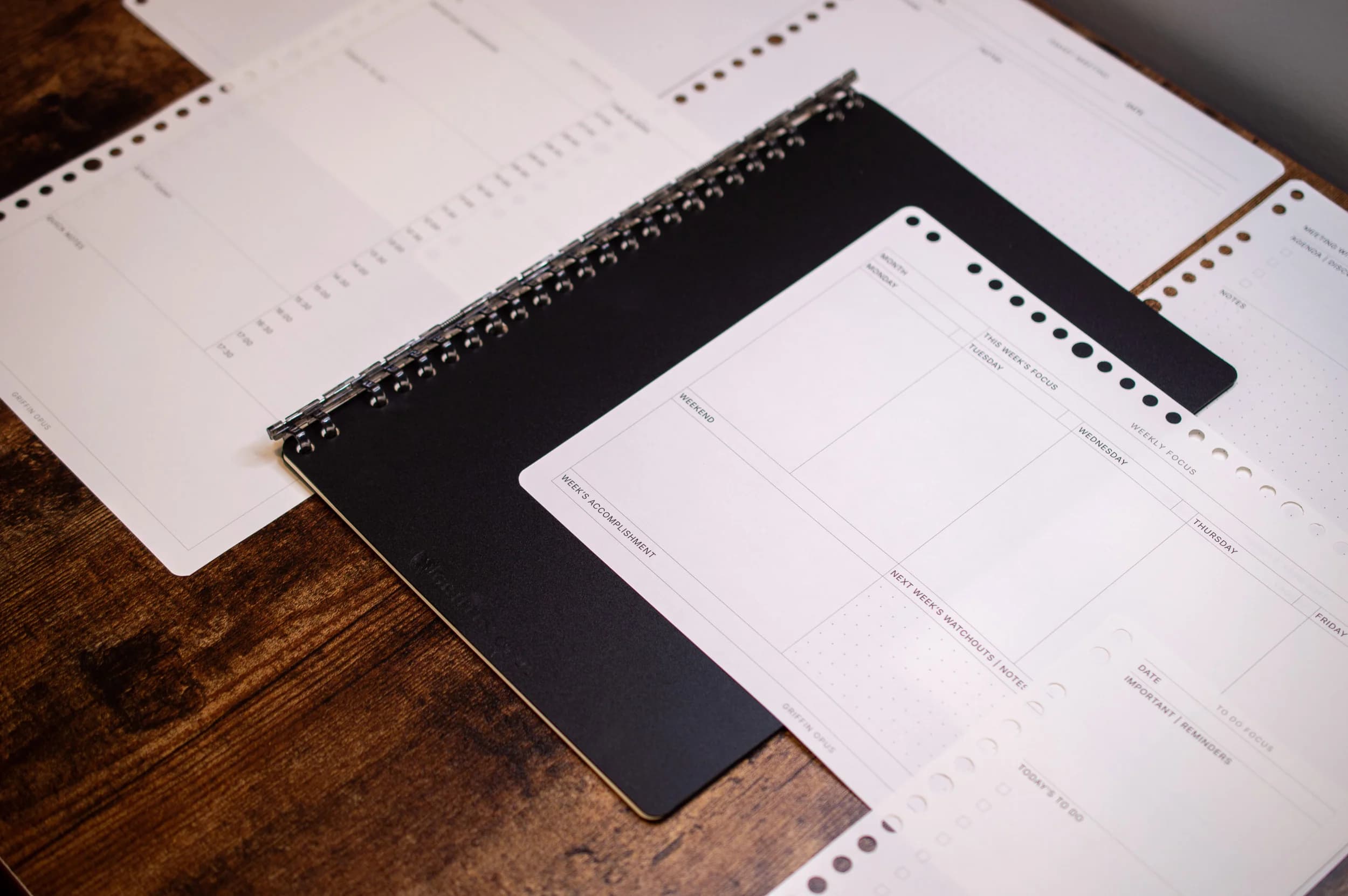
Most planners are abandoned by February. Not because the person lost discipline, but because the book stopped matching the work. You bought a fixed layout in December, and by late winter your responsibilities had quietly rearranged themselves around it. The pages didn't move. You did. The way to build a paper system that survives the year is to stop buying a finished answer and start assembling one that can change.
Why fixed planners break
A bound planner makes a bet: that the shape of your year is knowable in advance. It commits every week to the same grid, the same ratio of calendar to notes, the same assumptions about how you work. When a new project lands, or a role shifts, or a habit falls away, the book has no way to respond. You end up writing around it, then past it, then not at all.
The alternative is to treat structure as something you own rather than something you're issued. A modular system separates the container from the contents. One binder holds the whole thing together; the pages inside are chosen, ordered, and replaced by you. Nothing is glued to a calendar you no longer keep.
Give every page one job
The organizing principle is simple: each page does exactly one thing. A weekly plan is a weekly plan. A meeting page is a meeting page. A project tracker tracks one project. When a page has a single job, you always know where something goes and where to find it later. When a page tries to do four jobs at once, it does all of them poorly, and you stop trusting it.
This is also what makes the system able to grow. Because each page is self-contained, you can add one without disturbing the rest, or remove one that has quietly gone dead. The setup is never finished, which is the point. It's a working arrangement, not a monument.
The best system is not the one with the most pages. It's the one you still recognize six months from now, because it changed as your work changed.
A method for building it
Start by naming the work you actually repeat. Not the aspirational version, the real one. Most people have three to five recurring jobs that make up the bulk of a week: planning what's ahead, running meetings, tracking a handful of live projects, capturing loose thinking. Those recurring jobs are your page types. Everything else is noise you can leave out for now.
Then keep it small on purpose. A binder and a few inserts you genuinely use will beat a fully loaded system you're intimidated to open. Add pages when a real need appears, not in anticipation of one.
- List your three to five recurring jobs, in plain language, before choosing any pages.
- Give each job one page type, and start with only those.
- Arrange the pages in the order you actually move through your day, not alphabetically or by category.
- Keep a small notebook section for thinking that hasn't found its page yet.
- Once a month, remove anything you didn't touch and add anything you kept improvising.
The monthly review is what keeps the whole thing honest. It's a ten-minute prune: pull the pages you ignored, promote the scrap you kept reaching for, and let the setup drift toward how you really work. If you want one small action for today, name your recurring jobs on a single page. That list is the seed of a system that can grow with you instead of against you.
Quick answers
Can one system that grows with me be easier to stick with?
For many people, yes. Fixed planners get abandoned when the book stops matching the work. A modular system separates the binder from the pages, so you add or remove pages as your responsibilities shift. Because it changes when your work changes, many people find it easier to keep using past February instead of starting over.
How do I stop abandoning planners halfway through the year?
It can help to stop buying a finished answer and assemble one that can change. Give each page one job so you always know where things go, and swap inserts as the work moves. For many people, a system they still recognize six months in is the one that survives, because it grew with them.
Put it into practice
Build your system.
Start with the binder and add the pages that match how you actually work.
Build your system →